
Blog


Tháng Bảy, ngày 24 tháng 2 năm 2026
Góc nhìn của một nhân viên y tế cộng đồng về việc hỗ trợ các gia đình trên khắp tiểu bang Washington
Families often need support that extends beyond a doctor’s visit. Access to transportation, baby supplies, stable housing, language support, and trusted community resources can all play a role in a family’s health and well-being.
Community Health Workers are often the people helping families navigate those challenges. They connect patients with resources, help remove barriers to care, and serve as a bridge between health care systems and communities.
But Community Health Workers also need connections — trusted partners and reliable networks that help them find resources for the families they serve.
That’s where Help Me Grow Washington, WithinReach‘s flagship program, comes in. Offering a full spectrum of support for families with young children across Washington, Help Me Grow Washington serves as a trusted resource for both families and the professionals who support them.
Trong cuộc trò chuyện này, Kate Agyei Yeboah, Quản lý Quan hệ Đối tác Help Me Grow Washington, trao đổi với Alicia Brown, Nhân viên Y tế Cộng đồng tại Virginia Mason Franciscan Health, về những gia đình mà cô hỗ trợ, những thách thức họ gặp phải và cách mạng lưới nguồn lực toàn tiểu bang giúp cô phục vụ tốt hơn cho các gia đình mà cô đang làm việc cùng.
Kate Agyei Yeboah: For people who may not be familiar with Community Health Workers, can you tell us about your role and the work you do?
Alicia Brown: I’m a Community Health Worker with Virginia Mason Franciscan Health. I work in what’s called a specialty clinic, specifically women’s health.
The way I describe my role is that I help pair patients with community resources. Community Health Workers came out of research showing how social needs — or social drivers of health — affect a patient’s overall health and well-being.
The idea is that providers can focus on the medical side of care while I help with the social side. I work alongside providers and midwives to help address barriers that may prevent someone from getting the care they need.
Kate: You work primarily in women’s health. Can you tell us more about the communities you serve?
Alicia: We have physicians, midwives, and gynecologists, and I support our West Seattle, Des Moines, and Burien Women’s Health clinics.
We also serve patients who may live farther away but work in this area, or patients who transfer their care to us. We serve a large migrant population and many patients who do not speak English.
Occasionally, we also work with patients experiencing substance use, and I work closely with a social worker at the hospital’s birthing center to support those families.
Kate: What are some of the most common needs or challenges you see families navigating?
Alicia: Support is a huge one. Supplies are another, especially with the cost of everything today. Families with more than one child may need help finding things like baby supplies, whether that’s through Pregnancy Aid, a church, or other small community programs.
Transportation is another huge need. We want patients to be able to get to their OB appointments and receive the care they need.
I predominantly work with pregnant people and expecting mothers, but occasionally I also support gynecology patients who may be navigating challenges like billing systems or other barriers.
Every family is different. My work comes down to helping connect people with the support they need.
Kate: How did you first learn about Help Me Grow Washington, and how has it supported your work?
Alicia: I first learned about Help Me Grow Washington at a resource fair at the Burien Library.
Resources are limited nowadays. Not every community organization has the funding or language capacity to support every patient. When I can’t find what I’m looking for in the community, I think: “Help Me Grow.”
You have a much bigger view of what’s out there than I do. Because you’re statewide, you have access to resources that I may not even know exist.
Kate: What does Help Me Grow Washington support look like for your families?
Alicia: One patient who really stands out was in the Bremerton and Port Orchard area. This patient was too far along in her pregnancy to qualify for one program, and another program wasn’t available in her area.
There wasn’t a strong community resource center specifically for pregnant women, so I submitted a referral to Help Me Grow Washington.
Around that same time, I learned about the closed-loop referral feature. When I first started making referrals, that didn’t exist, so I always wondered, “Did they connect with the patient? What happened?”
It was so helpful to see that Help Me Grow had connected with her. I could see that she had received a gift card, and I learned about resources and partners I didn’t even know existed.
That helped the patient, but it also helped me. I’m learning about different communities, different resources, and different partners across the state.
Kate: How has Help Me Grow supported families who may face additional barriers accessing resources?
Alicia: It’s been especially helpful for many of my patients who are immigrants. Some families are afraid of government programs, worry they won’t qualify, or are concerned about what will happen if they share their information.
Help Me Grow has been a safe resource for many of those patients. That’s been huge because there’s a lot of fear, especially if you don’t speak English, you’re new to this country, and you’re already dealing with so many other challenges.
I’ve had patients decline resources because they’re afraid that if they accept help, they won’t be able to get help somewhere else, or that there will be consequences for asking for support.
Kate: You also support families experiencing substance use during pregnancy and postpartum. What challenges do you see when connecting these families to support?
Alicia: Substance use is a huge one because there aren’t always a lot of resources available, especially for pregnant people.
There are programs out there, but access can depend on where someone lives and what services are available in their community. Sometimes families need more support navigating what’s available and figuring out the next step.
Providers are there to monitor the medical side of pregnancy, but they aren’t always able to walk alongside a family through every resource connection. That’s where Community Health Workers and programs like Help Me Grow can be really important.
Sometimes a patient just needs a little more hand-holding, and Help Me Grow provides that connection.
Kate: After working with families and using Help Me Grow Washington as a resource, what stands out most to you about this partnership?
Alicia: I’m happy you all are there. I’m glad that Help Me Grow is a program focused on continuous improvement.
It shows that the heart is really there. It’s not just a program — it’s a program that wants to be effective and reach people.
You can tell there’s passion behind the work. It’s not just a job. I can tell from interacting with you that you want to do well and that you’re really trying to make sure families are supported.
Kate: What opportunities do you see for more Community Health Workers and other partners to connect with Help Me Grow Washington?
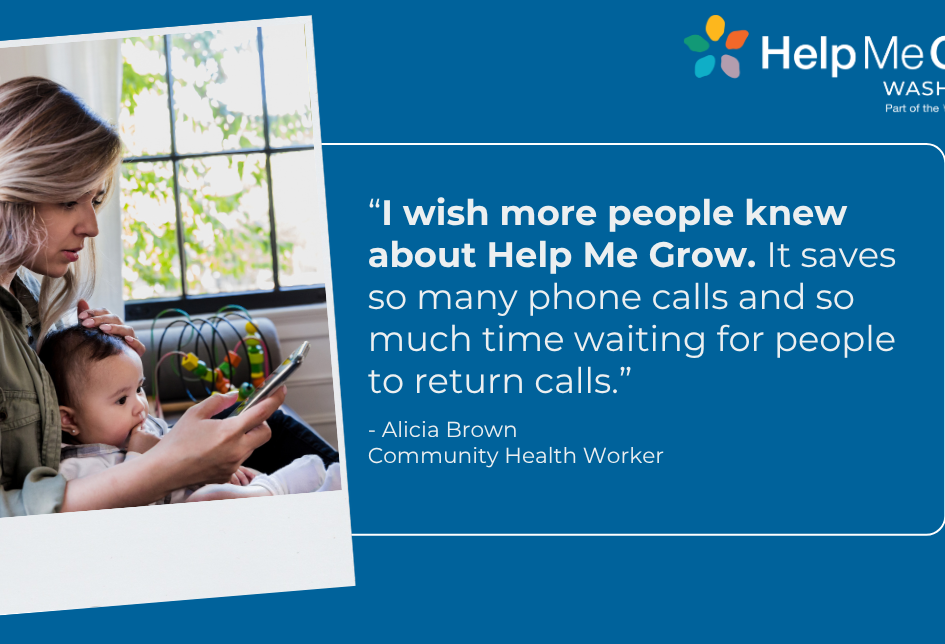
Alicia: I wish more people knew about Help Me Grow. It saves so many phone calls and so much time waiting for people to return phone calls.
I think schools would really benefit from knowing about this resource. Sometimes families are navigating financial challenges, clothing needs, transportation issues, or housing instability, and school counselors are trying to figure out what resources are available.
I also think about Community Health Workers in primary care and family medicine settings. Originally, our Community Health Worker program started in primary care, and I’ve been sharing with my team that Help Me Grow Washington can support families across the state.
Local partnerships are important, but sometimes there are limitations. Having a statewide resource means families can continue receiving support even if they move to a different community.